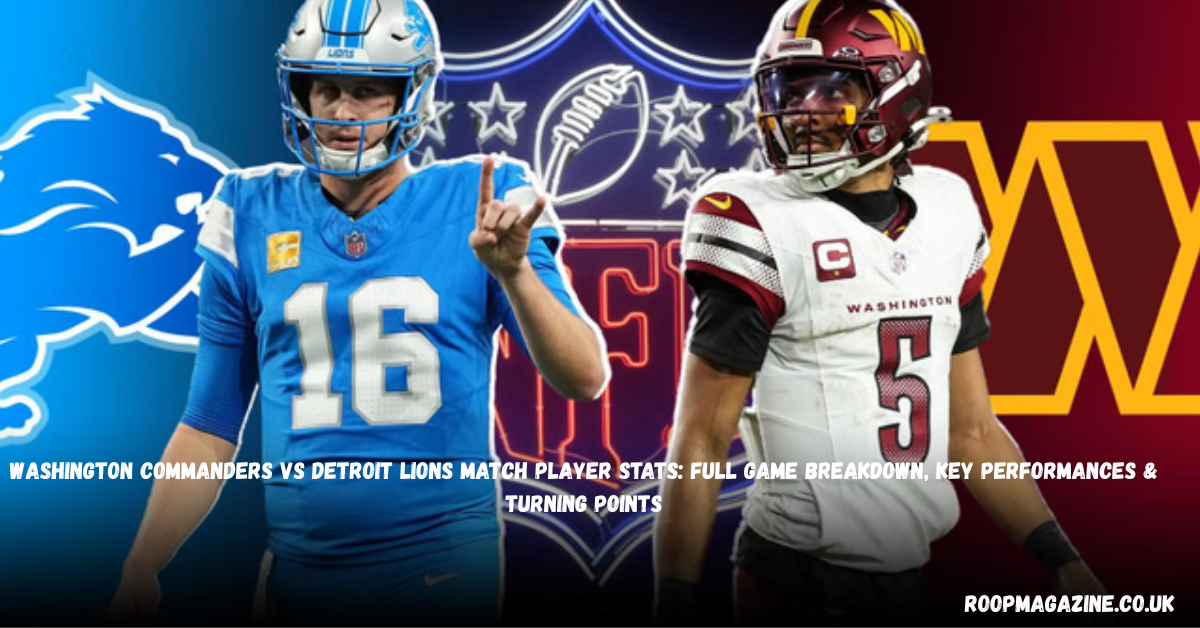
The Washington Commanders vs Detroit Lions match player stats reveal far more than just numbers on a scoreboard. This game was a powerful mix of momentum swings, individual brilliance, costly mistakes, and smart execution. While many expected a close contest on paper, what unfolded on the field told a much deeper story.
This article delivers a complete, SEO-optimized breakdown of the game, covering player stats, quarter-by-quarter analysis, key turning points, and what the result means for both teams going forward.
Game Overview – Commanders vs Lions Clash Explained
The Washington Commanders faced the Detroit Lions in a high-stakes matchup that carried major postseason implications. Detroit entered the game with confidence, backed by one of the league’s most productive offenses and home-field advantage. Washington, however, arrived with discipline, balance, and a clear plan to disrupt Detroit’s rhythm.
From the opening drive, the contrast in styles was obvious. Detroit leaned on explosive plays and tempo, while Washington focused on execution, ball security, and sustained drives. This clash of philosophies created an intense and entertaining game that stayed competitive deep into the second half.
Final Score & Match Summary
Washington Commanders: 45
Detroit Lions: 31
The final score reflects Washington’s ability to capitalize on opportunities. Despite Detroit gaining more total yards, Washington’s efficiency in the red zone and dominance in turnover margin proved decisive. A massive second quarter allowed the Commanders to take control, and they never fully surrendered that momentum.
Quarter-by-Quarter Game Breakdown
First Quarter – Fast Start and Early Momentum
Detroit struck first, opening the game with an efficient scoring drive that set an aggressive tone. Their running game established early physicality, forcing Washington’s defense to adjust quickly.
Washington responded calmly, moving the ball methodically and settling for a field goal. Although the Lions led after the first quarter, Washington showed signs of composure and control that hinted at what was coming.
Key takeaway: Detroit started fast, but Washington remained patient and composed.
Second Quarter – Offensive Explosion and Momentum Shift
The second quarter completely changed the game.
Washington exploded offensively, scoring 28 points in a dominant stretch that exposed gaps in Detroit’s defense. Big plays through the air, efficient red-zone execution, and short fields created by turnovers all contributed to the surge.
Detroit continued to move the ball, but interceptions and defensive lapses allowed Washington to build a commanding lead before halftime.
Stat highlight: Washington outscored Detroit by double digits in this quarter alone, creating the cushion that decided the game.
Third Quarter – Lions’ Comeback Attempt
Detroit regrouped after halftime and showed resilience. A long, well-executed drive resulted in a touchdown that narrowed the gap and briefly shifted momentum.
Washington’s offense slowed during this period, struggling to sustain drives. However, their defense limited further damage, preventing Detroit from fully swinging the game in their favor.
Fourth Quarter – Commanders Close the Game
With the game still within reach, Washington delivered its most mature football of the night.
Long, clock-controlling drives drained time and ended in touchdowns. When Detroit attempted to respond, turnovers halted their progress. Washington capitalized immediately, sealing the game with disciplined execution and smart decision-making.
Washington Commanders Player Stats Breakdown
Quarterback Performance – Commanders Signal Caller Analysis
Washington’s quarterback delivered one of the most composed performances of the season. He showed excellent decision-making, avoided turnovers, and consistently found open receivers.
- High completion efficiency
- Strong passing yardage
- Multiple touchdown passes
- No interceptions
His ability to extend plays with his legs did not always show up heavily in rushing totals, but it kept drives alive and frustrated Detroit’s pass rush.
Running Backs Performance – Rushing Stats & Impact
Washington’s running backs focused on consistency rather than flash.
- Tough inside runs
- Effective red-zone carries
- Positive yards after contact
The lead back finished with multiple touchdowns, while the overall rushing attack helped control tempo, especially late in the game.
Wide Receivers Performance – Receiving Leaders
Washington’s receivers delivered timely production:
- One receiver surpassed 100 receiving yards
- Multiple players contributed meaningful catches
- Big plays stretched the defense vertically
Rather than relying on a single target, Washington spread the ball effectively, keeping Detroit’s secondary off balance.
Tight Ends Contribution
The tight end group played a crucial supporting role:
- Reliable third-down conversions
- Solid blocking in the run game
- A red-zone touchdown contribution
These understated contributions helped sustain long drives.
Washington Commanders Defensive Player Stats
Washington’s defense was opportunistic and disciplined:
- Multiple interceptions
- Strong red-zone defense
- Pressure at key moments
While they allowed yardage, they excelled when it mattered most, forcing turnovers and limiting Detroit’s scoring efficiency.
Detroit Lions Player Stats Breakdown
Lions Quarterback Performance – Accuracy and Control
Detroit’s quarterback produced strong passing numbers, throwing for over 300 yards. However, turnovers overshadowed the performance.
- High passing yardage
- One passing touchdown
- Multiple interceptions
The interceptions repeatedly ended promising drives and shifted momentum back to Washington.
Detroit Lions Running Game Analysis
Detroit’s rushing attack was productive:
- Over 100 rushing yards from the lead back
- Multiple rushing touchdowns
- Physical running style
Despite the success, the running game could not fully offset the impact of turnovers.
Detroit Lions Wide Receivers Performance
Detroit’s receiving corps delivered explosive plays:
- One receiver exceeded 130 yards
- Several contested catches
- Effective route running
However, key drops and miscommunications at critical moments limited their overall impact.
Detroit Lions Defensive Stats & Impact
Detroit’s defense struggled:
- Allowed over 45 points
- Gave up long scoring drives
- Failed to generate enough turnovers
Missed tackles and coverage breakdowns during the second quarter proved costly.
Head-to-Head Team Stats Comparison
Offensive Comparison
- Total yards: Detroit slightly ahead
- Passing yards: Detroit led
- Rushing balance: Both teams effective
Defensive Comparison
- Turnovers: Washington dominated
- Red-zone defense: Washington far more efficient
- Pressure: Even, but Washington capitalized better
Time of Possession & Drive Efficiency
- Washington controlled the clock late
- Detroit struggled to finish drives
Key Turning Points That Decided the Game
- Second-quarter scoring surge by Washington
- Multiple Detroit turnovers
- Explosive touchdown reception before halftime
- Fourth-quarter clock-killing drives
Momentum shifted decisively during these moments, and Washington never relinquished control afterward.
Tactical Analysis – Why the Commanders Won
Washington won because of:
- Superior ball security
- Excellent red-zone execution
- Balanced offensive play-calling
- Opportunistic defense
Detroit moved the ball well but failed to protect it, and that difference defined the outcome.
What This Game Means Going Forward
Washington Commanders Season Outlook
This performance confirmed Washington’s growth as a complete team. The offense showed balance, the defense delivered under pressure, and coaching decisions proved effective. The win boosted confidence and set a strong foundation moving forward.
Detroit Lions Season Outlook
Detroit must address turnover discipline and defensive consistency. While their offense remains elite, postseason success depends on execution in high-pressure moments.
Key Stats Summary Table (Quick Glance Section)
- Washington touchdowns: 6
- Detroit touchdowns: 4
- Turnovers: Washington 0, Detroit multiple
- Red-zone efficiency: Washington perfect
- Time of possession advantage: Washington
Conclusion
The Washington Commanders vs Detroit Lions match player stats highlight a game decided not by raw yardage, but by execution, discipline, and timing. Washington played smarter football when it mattered most, while Detroit’s mistakes proved too costly.
This matchup stands as a reminder that efficiency beats volume, and that football games are won in moments, not just metrics.
FAQs
Q1: Who was the best player in the game?
Washington’s quarterback stood out due to efficiency, leadership, and mistake-free football.
Q2: Did turnovers affect the final result?
Yes, turnovers were the biggest deciding factor in the game.
Q3: Which team had better offensive efficiency?
Washington was more efficient, especially in the red zone.
Q4: What was the biggest turning point?
The second-quarter scoring surge by Washington.
Q5: Why are match player stats important?
They reveal momentum shifts, execution quality, and areas for improvement beyond the final score.